
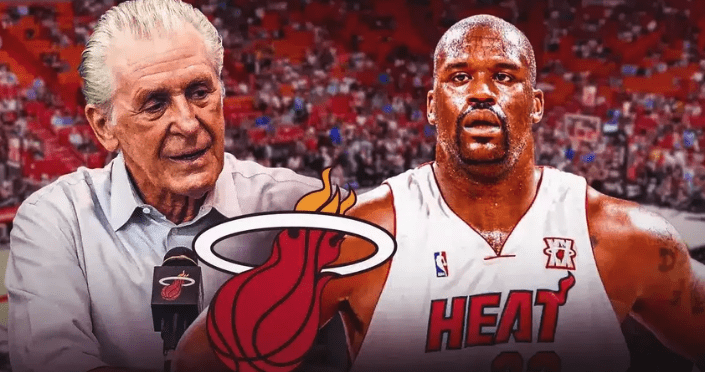
Players like Shaquille O’Neal simply don’t come around often. At 7-foot-1 and roughly 325 pounds in his prime, Shaq moved with shocking speed for a man his size. Add elite coordination, rare body control, and overwhelming strength, and the result was one of the most dominant forces the NBA has ever seen. Thanks to our friends at Basketball Network for info on this story.
That version of Shaq reached its peak in Los Angeles.
Alongside Kobe Bryant, O’Neal led the Lakers to three straight NBA championships from 2000 to 2002, earning Finals MVP honors each time. During those years, it often felt like there was no defensive scheme, no double-team, and no rule adjustment that could slow him down. When Shaq caught the ball deep in the paint, the outcome was almost inevitable.
Despite frequent criticism about his conditioning, O’Neal was still physically overwhelming as a Laker. But as he later admitted in his book Shaq Uncut: My Story, things began to change once he arrived in Miami.
And in Shaq’s view, that change had a lot to do with Pat Riley.
“There’s no question by trying to get my body fat down I became more injury prone,” O’Neal wrote. “I never had any of the ticky-tacky injuries I got until I went to Miami.”
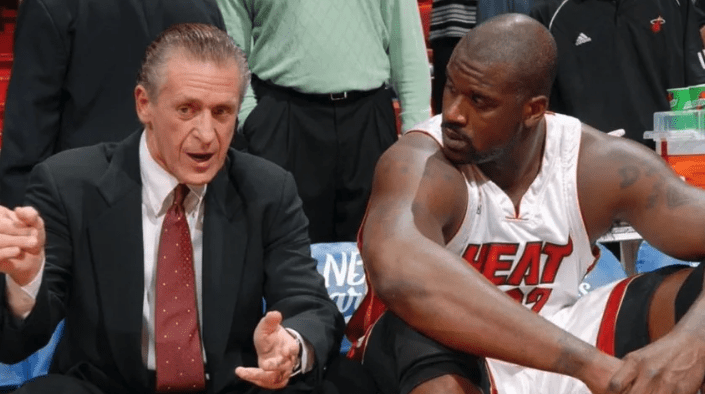


According to Shaq, slimming down removed the very thing that made him so durable for so long — mass. His longtime massage therapist even warned that a leaner frame wouldn’t absorb contact the same way.
“I had no cushion, no buffering,” Shaq explained. “I was too much of a power player to take that kind of abuse on that lean of a body.”
O’Neal arrived in Miami as one of the most accomplished players in the world, fresh off three titles and still producing elite numbers. Even in his final season with the Lakers, his “decline” included averages of 21.5 points and 11.5 rebounds — numbers most big men could only dream of.
Still, the wear and tear was real.
Shaq’s relaxed approach to conditioning famously frustrated Kobe Bryant, and that difference in mindset ultimately helped split up one of the most dominant duos in NBA history. Shaq didn’t obsess over longevity — as long as he was dominating, he believed he was doing his job.
In Miami, however, things were different.
Pat Riley was building what would later be known as “Heat Culture,” and O’Neal chose not to fight it. Despite his reservations, he committed fully.
“I didn’t see how I could get down to 10 percent body fat,” Shaq recalled. “But I didn’t want to hear the flack I’d get for not conforming.”
The adjustment took time, but it paid off.
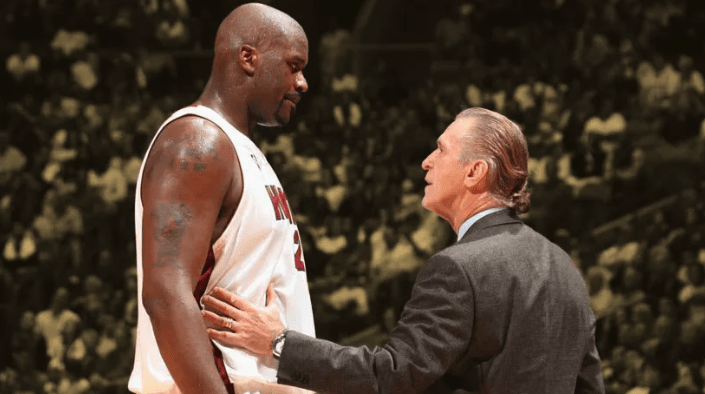
In his second season with the Heat, Shaq accepted a reduced role and handed the keys to a young, explosive Dwyane Wade. For the first time in 13 seasons, O’Neal didn’t average a double-double. His scoring dipped to a career-low 20.0 points per game, and his playoff production dropped even further.
And he didn’t care.
Shaq did what winners do — he adapted. Miami captured its first NBA championship, and O’Neal earned his fourth ring by putting team success ahead of personal dominance.
Pat Riley anticipated the decline and built accordingly. Shaq’s power may have diminished when the weight came off, but his impact didn’t. In the end, his Miami years didn’t erase his dominance — they redefined it.